Thursday, August 2, 2012

Smoke On The Water

Celebration of Light barge photo by Junie Quiroga
Every year around the last week or so of July a barge gets towed into English Bay and placed in position for staging the annual fireworks display.  Originally called the Symphony of Fire, but now known as the Celebration of Light, this annual orgy of competitive pyrotechnics has been going since 1990 and has featured entries from countries around the globe, most notably China, Spain, Mexico, Italy, Brazil, and even Canada.  Spread out over 3 nights it has attracted practically everyone in the Lower Mainland at one time or another, and always brings in an estimated crowd of  300,000 - 500,000 fans.

Fenced gardens photo by Junie Quiroga

But it isn't just the barge that needs to get set up for the fireworks display, it also means putting up protective fencing around all the carefully planted gardens, objects d'arte, and nearby restaurants.  As a resident of the west end with a perfect view of the fireworks from my apartment, I also have a perfect view of the disruption to my neighbourhood caused by this annual invasion, not to mention the aftermath of the event with all its litter and trash.  But one person's garbage dump is another persons treasure chest and, along with the temporary workers recruited in the early hours, things do manage to get pretty much cleaned up in time for my morning swim.


Man with metal detector & parks board cleaning machine photo by Junie Quiroga
In spite of the disruption to the neighbourhood, the food merchants are more than happy to have customers lined up for dinner.  Between the hot dog vendors, new fusion food carts, sushi shops, and doner/gyro/shawarma rotisseries there is a tasty fast food item to satisfy every taste and plenty of fancy restaurants for those with more refined tastes.  In fact, catering to the well heeled has become an ever imaginative and expanding aspect of the event.
 
Fenced in art photos by Junie Quiroga

In earlier times it was first come first served when it came to finding a spot on the beach or the grass, never mind the food outlets, but now there are bleachers set up with reserved seats, VIP seatings at the Boathouse, Keg Lounge Bathhouse, and the Cactus Club and, for the truly special, a new private dining barge in the Bay off of 2nd Beach.  Mind you, the really special folks simply fire up their own boats and cruise out into the harbour where they can then jockey for whatever they consider to be a good viewing position.  Money, after all, is no object when it comes to fireworks displays like this one which cost millions to stage.

Bleacher seating photo by Junie Quiroga
Private dining barge photo by Junie Quiroga
Meanwhile, back in the shadows, the emergency services crews are busy taking up position in preparation for any mishaps.  With its checkered history of crowd control, Vancouver has to employ an army of police on land, rooftops, water, and in the air to make sure everyone behaves reasonably and the streets are cleared in good order when everything is over.  They also have to deal with the inevitable medical problems that occur in such a large gathering of people who have been soaking up the sun and booze for so many hours.  It makes me shake my head when I compare the behaviour of our citizens in a public setting to those in other countries but there isn't much that can be done unless the city closes itself off to the suburban rabble who make a sport of invading the downtown on any pretext.

Emergency services command centre photo by Junie Quiroga
English Bay crowds & boats photo by Junie Quiroga
Nonetheless, as the day progresses and the crowds of people and boats starts to build, so does the anticipation until finally at 10pm. the lights on the barge go off and the show begins.  And what a show it always is for the next 30 minutes as all the carefully packed skyrocket cannisters are exploded in a synchronized pattern of noise and light with brilliantly coloured spiders, peonies, palms, rings, and crossettes, humming, whistling and banging into the night air.  The oohs and aahs accompany every shell burst as we collectively imagine the universe being created and destroyed until it finally ends in a wonderfully orgasmic finale, and all that's left for another year is the smoke on the water.

Fireworks photos by Junie Quiroga

Sunday, July 22, 2012

Come Together

Harbour Seal

With the ocean warming up a little in summer I find myself occasionally sharing the waters of English Bay with a few other swimmers who have also discovered the pleasures of swimming in the natural environment.  If our paths cross and we stop to chat this will often attract a curious seal or two who like to pop up from the depths and listen to the conversation.  Usually only showing their head and gorgeous eyes, these shy, little messengers of Neptune (or "Neptune's eyes" as they are referred to by the artist and sculptor, Debra Bevaart) haven't got a threatening bone in their body.

Neptune's Eyes sculptures by Debra Bevaart
Non possessive in every sense, they share fishing territory and haulouts with other seals, change mating partners every year. and are quite content to cautiously interact with groups of swimmers or divers whenever they have an encounter.  Fishermen of course are another story, and the seals are quite happy to deprive them of their catch without any qualms or consideration for their trolling efforts. I suppose it's also hard to say thank you when your mouth is full of fish.

Harbour seal with a salmon
This uneasy relationship between fishermen and seals has been going on for a long time, with the fishermen trying unsuccessfully to bring back a cull of the seals (which ended in 1970 when there were only an estimated 10,000 seals left) who they see as competitors for what they perceive to be an ever shrinking supply of fish.  Without getting into a debate over the rights of one group or another to wipe out the fishery, the one thing that everyone agrees on is that the Harbour seal population has made a comeback and continues to increase every year with 125,000 being the latest population estimate.  What nobody seems to understand is the seal population couldn't get that large if there wasn't plenty of fish for them to eat.

Dall's porpoise photo by Junie Quiroga
While Harbour seals love a good salmon dinner as much as the next person, various rockfish, herring, and hake make up the bulk of their diet. Herring and hake is also a favourite fish of the Dall's porpoise, a high speed cetacean if there ever was one, and one that likes to ride the bow wave of your boat if you are lucky enough to encounter one.  International attention was brought to the Dall's porpoise when it was revealed that thousands of them were being caught in salmon fishing nets and accidentally killed.  In spite of this and the fact the Japanese are licensed to kill 16,000 of them annually, they are not yet considered an endangered species.

Dall's porpoise photo by Junie Quiroga
On the other hand there is another herring lover which is a threatened species, and that's the Steller sea lion which mostly lives and breeds further north but can be found in the waters of Georgia Strait, particularly in herring season when they flock to one of their favourite haul-outs off of Hornby Island and frolic with scuba divers.  The overfishing of herring in the past, particularly for their roe or eggs which are a delicacy in Japan, caused the Pacific herring fishery to partially collapse in the 1960's and then again completely in 1993.  How the Fisheries Department could allow such a vital link in the food chain, for not only the marine animals but also birds and of course salmon, to fall apart is almost unbelievable until one looks at what happened to the Atlantic fishery and the West Coast salmon fishery to realize how systemic this type of thinking is in our country.

Steller sea lions and Nelson Quiroga at Hornby Island

The good news though is that herring stocks are slowly rebuilding which, in turn, is allowing the populations of Harbour seals and Dall's porpoises to increase, and is also thought to be responsible for the return of the occasional Humpback whale in these waters and a group of Pacific white-sided dolphins who have been making numerous appearances in Howe Sound and on either side of Georgia Strait.  Instead of considering  these creatures as competitors they should be viewed as indicators of things finally going right for a change.  Let's see how long the Fisheries folks can resist the pressures of the commercial fishery to destroy things again.

Transient killer whale photo by Junie Quiroga
Another thing people tend to forget is that Nature will keep things in balance all on its own.  With an abundance of seals and other marine mammals in the area yet another cetacean has made an appearance lately, and that is the Transient killer whale.  Unlike the Resident killer whales which have evolved to eat only salmon, this Orca species does not eat fish and only eats seals, sea lions, porpoises, dolphins, and other whales. They too have made a significant comeback from only 50 in the 1970's to over 250 of them identified as now plying the waters between Washington and Alaska including of course Georgia Strait.

Transient killer whales photo by Junie Quiroga

We were fortunate enough to be one of the first boaters to recently come across a small pod of Transient killer whales off of 3rd Beach who eventually scooped up one of the Harbour seals and then went on their way.  A bit of a happier story for a Harbour seal in Nanaimo around the same time who made an emergency escape onto the swim grid of a sports fisherman who spirited him away from the killer whale pod.  With a ban on the fishing of herring, the seals make a comeback, as do the killer whales, and then a fisherman saves a seal.  Strange how it all comes together.


Wednesday, July 11, 2012

Laughing or Make Me Smile

A-Maze-ing Laughter Sculpture

Adjacent to the beach at English Bay is a little patch of green known as Morton Park Triangle that, over the years, has become a premier location for hosting public art exhibits.  It started in 1998 when Buschlen Mowatt Galleries and the Vancouver Parks Board started a bi-annual/Biennale sculpture exhibition of international artists with pieces of public art strategically placed along various walkways, parks and beaches.  At any time folks could walk around the sculptures, touch them, and take pictures, and it was all free.


Everyone had their favourite sculpture, but there has never been a sculpture as popular as the A-Maze-ing Laughter collection of huge, bronze figures set up in the Morton Park Triangle. Each of the 14 happy bronze-cast males is 8.5 feet tall and weighs 551 pounds. For whatever reason these grinning statues, depicting the artist's face, have captured the public imagination and, throughout the day, children and adults can be seen climbing on the statues, posing for photos and trying to mimic the poses.

A-Maze-ing Laughter & Ella Kinnear photo by Junie Quiroga

It isn't just people wanting to get their photo taken, it seems there are others who want to contribute some of their own artistic flair to the exhibit, a tribute as it were to the creator.  One example being the Christmas morning decorations that mysteriously appeared and then just as mysteriously vanished.  Might even have been Santa himself making a guest appearance.

A-Maze-ing Laughter Xmas photo by Junie Quiroga
Recently there was the boating safety awareness campaign that outfitted all the happy chaps with their own life jackets and, as this type of guerrilla marketing catches on, I can only imagine some of the other costumes that will start to appear.  It's all a bit ironic when one considers the creations of the artist, Yue Minjun, a leader in the Chinese artistic movement known as Cynical Realism, are in response to the suppression of freedom following the Tiananmen Square demonstrations.  Even though we live in a land of complete political and artistic freedom, there's something about these sculptures that draws us into their happy embrace.

A-Maze-ing Laughter Boat Safety Awareness photo by Junie Quiroga

Like all the other artwork on display, the A-Maze-ing Laughter sculpture was only meant to be a temporary exhibit until it could be auctioned off.  However, because of its popularity, a proposal was made to keep it in Vancouver for at least 20 years and Yue Minjun agreed to drop the price of the piece from $5 million to $1.5 million.  Two donors were found who were willing to buy the work at the reduced price, but only if the sculptures were given a long-term home on the site by English Bay.  A deal was made with the Parks Board and now A-Maze-ing Laughter, Vancouver's most photographed art exhibit has a permanent home.  If there's one universal emotion that brings us all together it's laughter, and it's amazing indeed what a little laughter can do.

Tuesday, July 3, 2012

Bridge Over Troubled Water

There seems to be a lot of hysteria over the two proposed pipeline options for carrying oil from the tar sands of Alberta to tankers in either Vancouver in the south or Kitimat in the north, that strikes me as NIMBYism (Not In My Back Yard) at its worst or hypocrisy at its best. With car choked freeways and new bridges being built to accommodate suburban sprawl, and no attempt being made to reduce automobile use, it's quite obvious how dependent we are on the automobile economy in spite of our feigned objection to the main ingredient they run on.  And electric cars and trucks won't make any difference either because when you charge them up at night the power grid will still have to run on something, whether it's hydroelectric, nuclear, or some flavour of fossil fuel (coal, gas, or oil). 

One way of reducing automobile use might be licensing fees. Compare automobile licensing and registration fees in Copenhagen & Singapore where you pay a minimum of 100% of the car's value as an annual registration tax and, in the case of Singapore, you must also bid for a certificate of entitlement on an open auction as part of the country's strictly regulated vehicle quota system.  Shanghai has a similar system with a monthly quota on new license plates being sold at auction with the average price being over $10,000.00 and Hong Kong charges an average of $1,500 per year for licensing fees.

Singapore traffic

Of course no politician in this country would risk any change to the status quo so, reduced automobile use is not something likely to occur in the near term smoggy horizon but, we can continue to smugly point our fingers at people elsewhere who also need oil.  If the main objection is an oil leak occurring in the Salish Sea (Georgia Strait) or somewhere off the coast of Haida Gwaii, then perhaps all we need to do is look at the problem a little differently and put the pipeline terminus somewhere else.


Given the treacherous nature of Hecate Strait outside of Prince Rupert and the tricky navigation of Douglas Channel that also leads to Hecate Strait from Kitimat, it's easy to see why folks are worried about oil supertankers in these waters.  Vancouver, however, is a different story with the only oil spill  we've had being caused by a backhoe doing some routine municipal work and inadvertently puncturing a pipeline in the process.  There has never been an oil tanker spill (in spite of one leaving every 3 days) because every oil tanker leaving Vancouver has 3 tug boats attached to it until it safely reaches open water.  Nonetheless Vancouverites aren't going to allow themselves to be the perceived sacrificial lamb in order to save the fragile North so basically we have a stand-off in spite of the federal government's determination to push through the pipeline.

Oil tanker passing under 2nd Narrows Bridge
Oil tanker loading up in Burnaby photo by Junie Quiroga

If the oil pipeline terminus was located in Victoria or Port Alberni, both well established deep water ports more than capable of handling oil tankers, the problem would immediately shift to the west coast of Vancouver Island which has only open sea between it and mainland China, or anywhere else in the Far East for that matter.  While it's true that an oil tanker spill in the Port Alberni Inlet would be devastating for the pristine Broken Island group, it's also true the inlet, or canal as it is often referred to, is very straight, easily navigable and quite safe to transit.  Combined with some tugboat support and the already mandatory marine pilot service, it's unlikely there would ever be a problem.  The same could be said for ships leaving Victoria once they had cleared Juan de Fuca Strait.


The problem now becomes one of getting the pipeline built to either Victoria or Port Alberni and here is where a little imagination might be useful.  While the distance from Vancouver to either city is less than 60 miles in a straight line, nearly half of it would need to be underwater, and an underwater pipeline would probably not be an option given the potential risk of rupture and the difficulty in servicing something operating in depths ranging from 500 - 1,500 feet.  But a pipeline attached to the underside of a bridge is a completely different option. and one that could potentially kill two birds with one stone.
Proposed bridge crossing routes

Getting a bridge built from Vancouver to Vancouver Island has been a dream of many British Columbians ever since the province came into existence.  While the necessary engineering is complex, unproven, and costly, it isn't impossible and the timing couldn't be better for getting it built at Alberta's expense.  A bridge that would finally connect Vancouver Island to the mainland while at the same time facilitating the transport of oil to a safer port is indeed a bridge over troubled waters and something we might wish to now seriously  consider.

Proposed floating bridge design

Thursday, June 14, 2012

Octopus's Garden

China rockfish

While invertebrates (animals without backbones) may be the most common life form under water, there are plenty of  colourful vertebrates (animals with backbones) as well.  For starters there are at least 68 species of rockfish in the Pacific Northwest that come in a wide variety of colours and patterns, and a selection of them can usually be found hovering around the rocks carefully watching any diver.  Of course where there are fish there are often fishermen, and one of the hazards of diving is avoiding the fishing lines of folks trying to catch one of these fish which can grown up to 2 feet in length.

Tiger rockfish

Lingcod guarding egg mass
The largest and most prized fish of course is the ling cod (though they have almost been fished to extinction in certain areas) and these fish, that can grow up to 5 feet in length, can be very formidable when they are guarding their eggs.  But a much friendlier and usually very curious cousin is the smaller 7 inch painted greenling, that will often accompany a diver as they swim about.  Even smaller, and the cutest fish by far, is the grunt sculpin, a Nemo like fish only 3 inches long that hops around doing its best to not bother anyone.

Painted greenling
Grunt sculpin
But the fiercest looking, ugliest, and a diver's most favorite fish of all is the wolf eel.  It isn't really an eel, it just looks like one, but these fish are loaded with character.  They mate for life, and can usually be found resting together in their dens watching TV.  They grow up to 8 feet in length and, whenever they can put away the remote control, they sliver through the water as effortlessly as a silk scarf floating in the breeze. Their favorite food is the spiny sea urchin, a porcupine like invertibrate the size of an orange or grapefruit, which they chomp down on with no regard for the nasty and incredibly sharp spikes that stick out all over. At well known wolf eel sites it's very common for divers to bring them a sea urchin and have them eating it out of their hand while cozying up for a little petting.

Wolf eel pair

Wolf eel
Perhaps even strangest of all is the 6 gill shark, a fish with very little known about them.  Distinguished by their extra gill and absence of a front dorsal fin they are quite large and can grow to over 26 feet in length.  Most of the time they live in extremely deep water but, for some reason in summer, they occasionally appear in the shallows of a few select locations.  It's considered a very rare find to encounter one of these docile beasts who appear to eat a variety of crustaceans and fish but are not known to have ever eaten or attacked a human.  I had the pleasure once of meeting one and actually petting it which you can watch on this YouTube link.     http://www.youtube.com/watch?v=193c928cuLU

6 gill shark

Outside an octopus den
While it's very rare to see a 6 gill shark and a wolf eel den can be a little hard to find sometimes, it certainly isn't difficult to find where a giant Pacific octopus lives.  These invertebrates have to be the messiest housekeepers going, simply throwing their trash outside the door where it piles up and makes it easy to locate their den.  Subsisting on a diet of mostly crab, (another invertebrate) which they usually like to wash down with a decent Chablis, these beasts are the largest octopus in the world growing to a typical weight of 50 pounds with an arm span of 14 feet.  (There are records of them weighing more than 165 pounds and having an arm span of more than 20 feet)

Giant Pacific Octopus
Highly intelligent and able to change colour to camouflage themselves, they unfortunately only live for 3 - 5 years.  A female octopus can lay up to 100,000 eggs but she then stops eating and tends the eggs until they hatch and she dies. Occasionally an octopus will try to interact with a diver, which can be a little intimidating as I discovered once with an octopus wrapped around me fondling my gauges and hoses and wondering why I was so ugly but, when he snatched my knife out of its holder and retreated with it back to his cave, I realized he was really a kleptomaniac. So much for the myth of the octopus garden which in reality is a mess of crab shells and stolen goods.

Saturday, June 2, 2012

Green Eyed Lady

Emerald Sea

The first thing one notices about the ocean in the Pacific Northwest, as compared to say the Caribbean, is the colour.  The beautiful azure blue of the warm Caribbean belies the fact its waters are basically a desert in comparison to the thick green soup of microscopic plant life in our cold waters that forms the basis of a massive food chain and makes it one of the most productive environments anywhere in the world.  Jacques Cousteau called the ocean here the Emerald Sea, and the vast numbers of fish and animals it supports make for an amazing underwater experience.

Nelson & dry suit photo by Junie Quiroga

However, scuba diving here is not for the faint of heart.  The cold waters require specialized gear, that is both bulky and heavy, to keep warm and dry, and the steep drop-offs and strong currents demand close attention be paid at all times to what you're doing. But the rewards are spectacular and very colourful.


Starfish cluster

The majority of the sea creatures one encounters are invertebrates, which means animals without backbones.  One of the most common invertebrates are sea stars or starfish of various shapes and colours which can be found clinging to rocks or piers where they feast on mussels, barnacles, and clams, all of which are another type of invertebrate belonging to the mollusc family.  If nothing else you quickly realize this is a world of eat or be eaten in the endless life and death struggle going on below the surface.

Anemone cluster
The top 20 - 30 feet of ocean are where the algae and plankton live, and their density makes visibility almost non-existent.  But once you get below them the waters are clear and you can usually see for 30 - 80 feet.  Unfortunately the algae also blocks out most of the sun so things tend to look a little black and white until you switch on your dive light and the colours of the light spectrum suddenly appear in all their glory. Bright green, purple and red anemones, the "flowers of the sea" cover rock walls while fields of giant white and orange plumose colonize other rocky surfaces.

Giant plumose anemone cluster

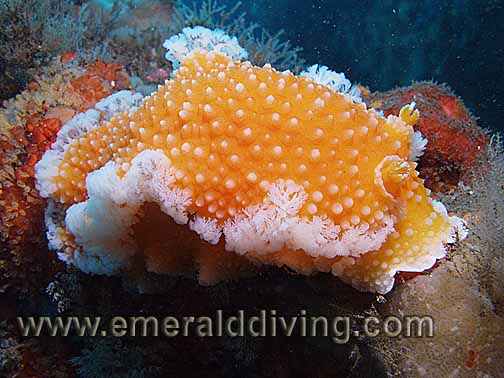
On land it's hard to get excited about slugs and, whenever we encounter one, we usually do our best to avoid touching them.  Under water it's a completely different story with what are known as sea slugs or nudibranchs.  "Nudis," as they are affectionately called by divers, are spectacular in their colours, shapes and markings.  Looking like slugs or hedgehogs or a combination of anything in between, these frilly orange, yellow, white, purple, and translucent animals have names like sea lemon, orange peel, shaggy mouse, and Spanish dancer, and are a particular delight to catalogue and photograph.

Alabaster nudibranch
Orange peel nudibranch

Giant dentronotid

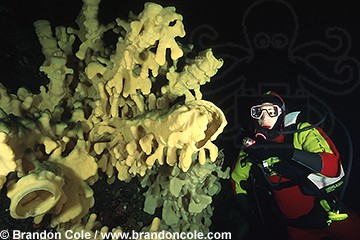
Another interesting group are the sponges which come in all sorts of shapes and sizes.  From orange tennis ball types, and yellow and purple patches forming crusts on the rocks, to massive and intricate cloud and chimney sponges that often have small fish and other creatures living inside them.  Chimney and cloud sponges can be found at depths of up to a few thousand feet but generally they are in the 80 - 100 foot range which is near the maximum depth a recreational diver is permitted to descend.

Cloud sponge
 
Chimney sponge

One of the principal pleasures of diving is discovering new sites and cataloging the creatures living there.  All it takes is the right combination of nutrient carrying currents and a strategically placed reef, wall, or shipwreck, to make it all come magically alive.  However, like any woman who wants to maintain her allure, there always has to be a little mystery, and so it is with the green eyed lady who keeps it all underneath waiting for an intrepid diver to discover.  More to follow.

Nelson & chimney sponge photo by Joseph Blackburn