Sunday, January 27, 2013

Cold As Ice


While technically no longer part of the Vancouver waterfront, Lost Lagoon was once a shallow cove at the end of Coal Harbour until the causeway through Stanley Park was completed in 1916 and turned it into a salt water lake (and a truly lost lagoon). Later in 1929 the pipes carrying salt water from Burrard Inlet were closed off and the lake was filled instead with fresh water and stocked with trout for the local fly fishing association.  In 1936 the lake was temporarily drained so a fountain for the City's Golden Jubilee could be installed, and then in 1938 it was made into a bird sanctuary. Up until the 1960's you could still rent row-boats in Lost Lagoon and enjoy a few hours on the water but this eventually came to an end and the lagoon was strictly set aside for the animals.

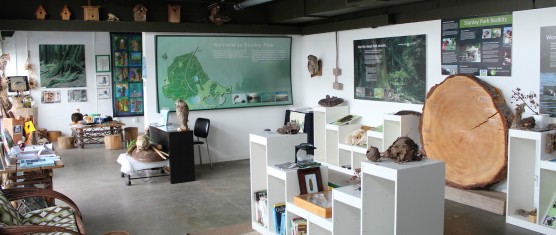
Inside the Stanley Park Nature House
The old boat house at Lost Lagoon has now been re-purposed as the Stanley Park Nature House, an informative little place staffed by volunteers of the Stanley Park Ecology Society and filled with all sorts of interpretive displays, photos, and creatures that are very safe to pet.  You can learn about all the various plants and animals who make the Park their home, identify the various birds, and go on discovery walks. You can also become a volunteer and help out with some of their programs like clearing away invasive weeds.

Small beaver suitable for petting

Lost Lagoon photo by Junie Quiroga
Besides the non-native swans and turtles and the migrating ducks and geese who dominate the area, there are a some furry mammals frequenting the place who could be mistaken for seals if lighting conditions were bad and you had too much to drink.  I'm referring of course to the river otters who use the Lagoon as a halfway house between Coal Harbour and 2nd Beach, and the beavers who've actually built a sizeable lodge at one end of the Lagoon.  Usually nocturnal, and very leery of any human contact, both the beavers and the river otters tend to keep to themselves, unlike the birds who love to pose for pictures.

River otters on the boulders by 2nd Beach photo by Junie Quiroga
Canada goose and red-eared slider turtles photo by Junie Quiroga
For most of the year, the birds enjoy a pleasant routine of mating with one another, swimming, showing off their offspring when they hatch, getting free handouts from tourists and kindly old ladies ignoring the signs to not feed the wildlife, and posing for all the bird watchers wanting to take their picture.  All in all a pretty good gig considering they get to live rent free in one of the more expensive and desirable parts of the City.  But come winter, when all good birds should be heading south, the ones left behind have to make do with conditions a little less pleasant.

Mother Goose & her goslings photo by Junie Quiroga

Ice on Lost Lagoon photos by Junie Quiroga


Killer Whales trapped in ice off coast of Inukjuak, Quebec January 2013
Because it's fresh water, ice occasionally forms on Lost Lagoon when there's a winter cold snap and then the creatures are kept busy either maintaining an open swimming hole or cleaning the ice so they have a nice skating surface. At least they aren't in the life or death situation a pod of east coast killer whales found themselves in at the same time last week with their pitiful attempt to keep a breathing hole open. Once again the old saying "West is best, East is least" makes Vancouver the envy of the country.

January 1993 skating on Lost Lagoon


Every 20 years or so the elements do combine for enough snow in the City to make life interesting for a few days and skating on Lost Lagoon a special treat.  It takes quite a few very cold days for the ice to thicken enough for skating, and thankfully it never lasts, but there is something special about a cold, sunny day outside on a frozen pond.  The West End feels like a real old fashioned neighbourhood with everyone laughing and playing together.

Beaver logging in Beaver Lake


A little further into the Park is the other freshwater lake called Beaver Lake, for reasons that are quickly apparent to anyone walking in the area.  Unlike Lost Lagoon which is in no danger of ever disappearing, Beaver Lake is following the demise of all forest ponds that slowly but surely fill in with rotting vegetation which, in this case, is aggravated by yet another introduced species, the water lily, that has taken the place over.  While a hungry moose would quickly help turn things around, the beavers in the meantime are doing their best to destroy all of the surrounding vegetation.  In spite of efforts to slow their logging operation by wrapping the base of trees with protective wire, the beavers have managed to build themselves quite a monster party lodge in the middle of the lake that, by all reports, is quite cozy when things freeze over.

Monster beaver party lodge in Beaver Lake photo by Junie Quiroga

Great Canadian beaver on display at the Nature House in Lost Lagoon
There is, however, one other body of fresh water in the Park that has nobody skating on it when it freezes, no lodge built in the middle for throwing parties, and nobody swimming in it either, and that's the 2nd Beach pool.  Lively all summer long, with the best sunset and ocean views, now it sits empty, deserted and cold as ice.  Oh well, only five months to go.

2nd Beach pool covered with ice photos by Junie Quiroga
 

Tuesday, January 1, 2013

Oh What A Feeling, What A Rush


Vancouver is so different from the rest of Canada in terms of climate and geography that it almost doesn't seem as if those of us who live here are actually Canadian.  Instead of flat prairie or muskeg and lakes we have mountains and the ocean and, instead of cold blizzards and snow, we have warm, gentle rain.  I think it's because we feel so guilty about living in an evergreen paradise we feel compelled to enact an annual ritual of suffering in the cold that lasts all of 20 minutes at best.


Of course what I'm referring to is the annual Polar Bear Swim that takes place in English Bay every New Year's Day once the revelers of the night before have had a chance to wake up.  If they aren't sober before they go into the water they certainly are when they come out.  But even a water temperature of between 45- 50 degrees Fahrenheit (7 - 10 Celsius) is nothing compared to the ice choked waters elsewhere in the country.


Actually it's the air that's colder than the water at this time of year but, when you are stripped down to nothing or next to nothing, there isn't much comfort in the difference of a degree or two.  Dealing with the water and air temperatures on a daily basis doesn't make it any easier for me either so, except for special occasions like the next century or millenium, I leave the ocean on this day to all the folks in costumes.  The seals also tend to go into hiding once they see what's happening.


According to the Coast Guard's 50-50-50 rule you only have a 50% chance of surviving in 50 degree water if you are in it for more than 50 minutes without proper gear so the swim is cut short for all those warm blooded animals who think they can be polar bears just for one day.  Of course some people think if they dress up as penguins, Elvis, Superman, or anything else with a supernatural connection to the cold it may give them an advantage, but it doesn't.  In less than 20 minutes they come out of the ocean with their costumes ruined and their dignity in shock as they frantically try to find a dry towel and get warmed up.


It's all in good fun of course and, while the rest of Canada still has 80 days of winter to get through, Vancouverites can go right back to sitting outside with their Starbucks coffees. Snow in Vancouver belongs on the local mountains where anyone feeling the need to play in the cold stuff can simply go skiing.  As for the real polar bears in Canada, oh what a refreshing feeling it is at this time of year, what a rush.


Thursday, December 20, 2012

Another Brick In The Wall Part 2


Aerial view of Stanley Park seawall
Without question, Vancouver's most popular attraction, for locals and tourists alike, is the seawall, a 22 kilometre source of civic pride running along from its starting point at Coal Harbour, around Stanley Park, along English Bay and Sunset Beach, all around False Creek, and the Olympic Village, and finishing up at Kits Beach.  Vancouver's newest billionaire, Dennis "Chip" Wilson, of Lululemon fame, has reportedly offered to help finance the extension of the seawall to its logical end at Jericho Beach, a 2.5 kilometre extension that would also connect with Spanish Banks.   If and when that's completed, the walkers, joggers, cyclists, boarders, roller-bladers, dogs, babies in carriages, and tourists will have an even more unparalleled route for taking in the waterfront scene and city views.

Storm damaged old seawall
But, while the new bits of the seawall are getting all the attention, with each section looking even better than the one before it, the original part of the seawall is really starting to show its age.  A couple of years ago an effort was made to repair some of the badly damaged sections (see my previous posting Another Brick In The Seawall http://www.blogger.com/blogger.g?blogID=4261237364096609595#editor/target=post;postID=2302302061745537069 ) but a recent very typical Northwest wind storm, combined with the highest tides of the year, quickly managed to create havoc along a number of other sections.  In doing so it also exposed the questionable construction techniques used in building and maintaining the seawall.

Storm damaged old seawall
While the City and the Parks Board have no problem coming up with novel ways to spend taxpayers money for bike routes and greenbelt initiatives they never seem to find the money to properly maintain one of their most important assets.  They also seem to have a double standard when it comes to safety concerns.  There are no railings to protect people from falling onto the rocks and water below and, on the busiest stretch of the seawall between 2nd Beach and Sunset Beach, there are no street lights, never mind the rest of the Stanley Park section.

Storm damaged old seawall
Putting up a sign that persons using the seawall do so at their own risk would be just another ignored distraction like the signs pointing out the speed limit and directions for cyclists and separation lines for pedestrians.  Even if it's for aesthetic reasons I don't see how the City can simply ignore the obvious need for a railing along the seawall.  Perhaps when a group of school children hurt themselves they will sit up and take notice.

Old seawall meets newly repaired seawall
The lack of street lighting is even more alarming when you combine this with the absence of a railing along the seawall.  Officials argue the cost of wiring up the seawall is prohibitive, not to mention the added electrical bill that would result.  But street lighting costs could be contained by installing solar and/or wind powered lights instead of miles of electrical conduit.  There would also be the added benefit of folks being able to go for walk in the dark without fear of assault or robbery.

Combination wind & solar powered street light
Railings and lighting are not as sexy as a seawall extension but maybe "Chip" could consider "chipping in" for this project as well and shame the City & Parks Board into following the same standards they impose on anyone else developing land next to the seawall.  Why is it that anything done by the private sector is so first rate but anything built or maintained by a government department is so sub-standard and shabby looking? Compare any stretch of the seawall in Coal Harbour or False Creek with the seawall on park land and you can see how it's really starting to show its age which, in some sections, is almost 100 years.

Coal Harbour seawall

False Creek seawall
English Bay seawall


Beach erosion 
Even less sexy, but more important, is the way drainage issues along the seawall are addressed. Not that it ever rains in Vancouver but, for those occasional months of the year when water is making a mud pit out of the poorly designed lawns and dead end walkways leading to English Bay, it would be nice if the water was directed to the storm sewer system instead of allowing it to erode the edge of the seawall, puddle on the walkway, and degrade the beach itself.  Even if the City & Parks Board doesn't care about the residents you think they would at least be sensitive to the impression it makes on the tourists.

Dead end walkway to the beach
So my Xmas wish for 2013 is the City & Parks Board not only announce a plan for expanding the seawall but also one for rehabilitating and modernizing the existing sections that need attention, particularly along English Bay.  Maybe they can even get Dennis Wilson to head up a fund raising campaign and get people to pay for a street light that would be named after themselves.  All in all after all we're only looking for another brick in the seawall.

Current & proposed seawall route

Saturday, October 6, 2012

Swim Don't Run

Michael Phelps swimming butterfly at 2012 London Olympics
Everyone has their favourite sport and, while the Olympics showcase just about every sport that exists, my favourite events of course are the swimming ones.  However, after watching the awesome performance of Michael Phelps in this summer's Olympics, I was struck by the fact of how few people there are who take up the sport of swimming.  This in spite of the fact 3/4 of our planet is covered in sea water and 80% of the world's population lives within 60 miles of the ocean.


100 million years ago mammals became the dominant animals on earth, the culmination of a 500 million year struggle to climb out of the primordial swamp and evolve into land based creatures. While mankind only started making its appearance in the last 200,000 years I guess it's no surprise that, after spending this much time getting onto land, the first choice in sports usually involves running in some form or another. There is some sort of innate reluctance for most mammals in general, and humans in particular, to get wet even if they are quite capable of being very good swimmers.


Nonetheless, in spite of finally getting their feet on dry land, an interesting thing happened about 50 million years ago when some of the mammals decided they wanted to get back into the ocean.  The reasons aren't exactly clear, but the most obvious one is that it was easier to get a bite to eat. Even today fish still provides the majority of humans with their protein, in spite of overfishing and everything else we've done, and the ocean, with its plankton based ecosystem, continues to support an incredible number and variety of fish, birds, reptiles and mammals.

Manatee

There are three main groups of marine mammals; the sirenians (manatees & dugongs),  pinnipeds (seals, sea lions & walruses), and cetaceans (whales, dolphins & porpoises), though polar bears and otters are also starting to be classed as marine mammals.  While pinnipeds spend most of their time in the water they are only considered semi-aquatic because they still have to mate, breed, and molt on land.  Sirenians and cetaceans on the other hand are fully aquatic ocean dwellers.

Stellar Sea Lion

In evolutionary terms it didn't take that long for the land based ancestors of cetaceans, sirenians, and pinnipeds to get back into the ocean (about 15 million years) but they didn't turn into fish and they still need to breathe air from the surface.  Amongst other things hands and feet adapted to become flippers and tail flukes for propulsion, lungs and other internal organs evolved to facilitate the high pressure of  being underwater for extended periods of time, and they developed blubber as a means of conserving heat and providing insulation.  Mankind, on the other hand, has been a little faster adapting to the ocean thanks to inventions like wetsuits for warmth, SCUBA gear for underwater breathing and, most importantly, developing a variety of swimming techniques that allows us to use the arms and legs we already have without waiting for them to turn into flippers.

Blue Whale

There are four primary swimming strokes now recognized by FINA, the international association that administers swimming competitions; backstroke, breaststroke, butterfly, and freestyle which is normally front crawl  but can be any form of swimming style.  It has taken approximately 100 years to develop these distinct swimming strokes and they continue to be refined and improved upon even to this day as scientists and coaches gain more knowledge about propulsion, hydrodynamics, and conditioning. Butterfly, the newest stroke to be developed, is the closest swimming style to that of the marine mammals and, in retrospect, given man's capacity to copy Nature, the one that should have been developed first.

File:Breaststroke.gif

From ancient pictures and drawings showing people swimming a primitive form of breaststroke it would appear this was the first stroke humans learned and it was certainly the most common stroke for most of the world until the 20th century.  By 1844 the sidestroke had also been developed and, along with breaststroke, were the only strokes used in swimming competitions organized by the National Swimming Society in England, in spite of being beaten by North American Indians who used a swimming style that resembled what would soon become known as front crawl. By the 1900 Paris Olympics an early form of backstroke (essentially an upside down breaststroke) was also a recognized swimming style.

File:Backstroke.gif

By 1895 the sidestroke had evolved to an overarm sidestroke and, in 1901, the forerunner of front crawl a stroke called the trudgen, was introduced (after John Trudgen who copied it from South American Indians, using a hand over hand style combined with a scissor kick). In 1902 the trudgen was modified  to combine an up and down kick with an alternating overarm stroke and became known as the Australian crawl after the Australian Richard Cavill who swam 100 yards in 58.4 seconds to win the International Championships. Cavill's technique had been inspired by a Solomon Island native who in turn came from a long line of Polynesian swimming tradition that was far more advanced than the Europeans. An upside down version of this stroke then became the new style of backstroke pioneered by Harry Hebner.

File:Freestyle swimming.gif

In the 1933 the breaststroke was modified by Henry Myers to use an out of water butterfly style arm action with the regular breaststroke kick and was called butterfly breaststroke. The dolphin kick, invented in 1935 by Jack Sieg, was not allowed to be combined with the butterfly arm action until the 1950's when it was finally recognized as a separate stroke for competition. Breaststroke then went back to a stroke with the arms recovering in front of the breast and the 1956 Melbourne Olympics was the first year the four recognized competitive swimming strokes were on display.

File:Butterfly stroke.gif


Johnny Weissmuller
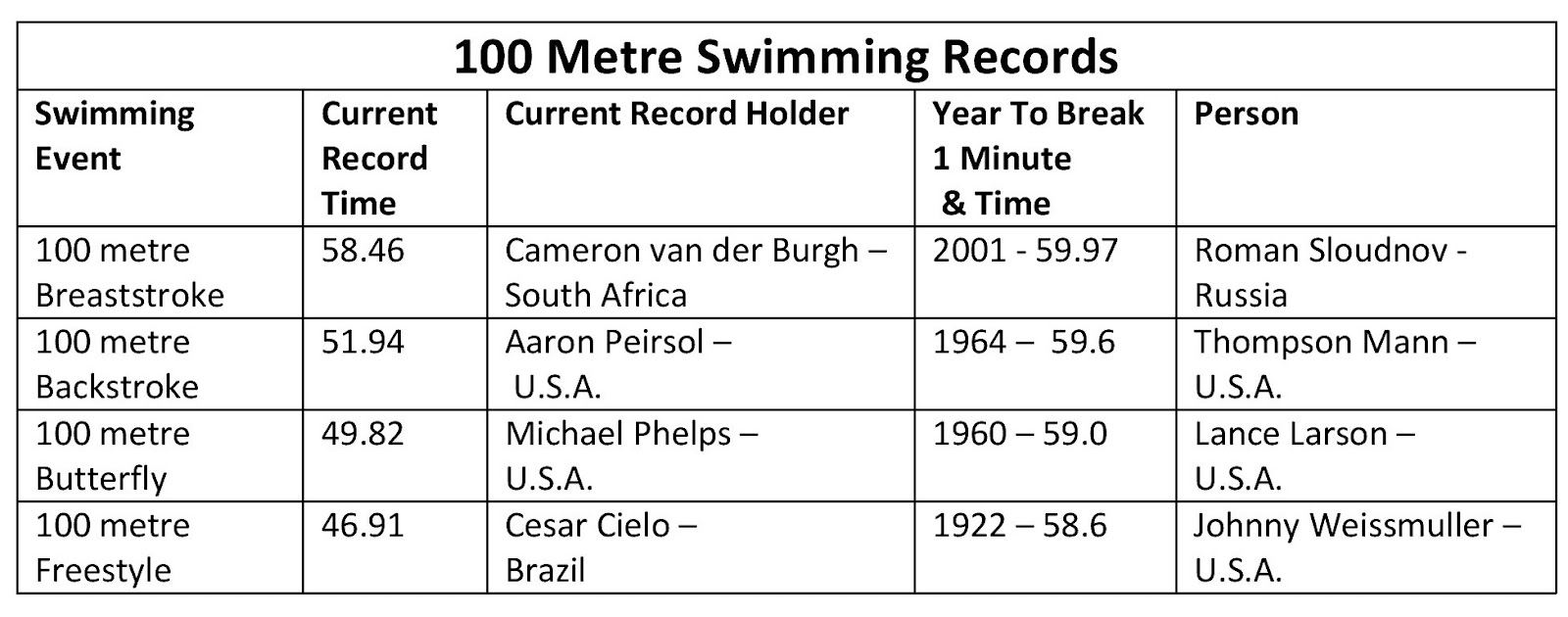
The first person to break the one minute mark in any 100 metre swim was Johnny Weismuller in 1922, a man more famous later for playing the role of Tarzan in the movies, than the freestyle swimming record he held for 12 years. It took until the 1960's before anyone swimming butterfly or backstroke could break the one minute mark, and it took until 2001 before the one minute mark was broken for breaststroke.  Since then the constant refinements of various techniques in each of the swimming strokes has led to new records being broken almost every year with the exception of the occasional superstar like Mark Spitz who held  the butterfly record from 1967-1972 and the freestyle record from 1970-1975.

Mark Spitz
The current swimming champion of the world is Michael Phelps with his record Olympic medal haul and domination of the butterfly, his signature stroke.  The attention he has drawn to this stroke has made it a favourite of swimmers everywhere, even if it is the most difficult one to master.  With its perfect symmetry and close resemblance to the swimming style of all other marine mammals it may one day be faster than front crawl. 

Michael Phelps

But swimming isn't all about speed.  In fact most swimming is about keeping a measured pace for a certain period of time with perhaps only occasional bursts of speed.  With the exception of perhaps water polo, swimming is for the most part a solitary sport and, even if people are swimming with someone else, there isn't much opportunity to chat.  Swimming can be done in pools or in open water, but it's in the open water where the solitary nature of the sport really catches people's imagination particularly after Byron made his famous crossing of the Hellespont in 1810, a distance of between 1 -3 miles depending on current and the actual entry & exit points.

Captain Mathew Webb
But whether it's romantic inspiration or simply folks wanting to pit themselves against the open water, the most famous open water swim is of course the English Channel.  The narrowest point between Dover and Calais is 21 miles and the first person to succeed was Captain Mathew Webb in 1875 and it took him 21:45 hours doing breaststroke.  By 1923 the record was down to 16:33 hours until Gertrude Ederle completed it in 1926 in 14:39 hours becoming not only the first woman to complete the swim but also the first person to do it using front crawl. When she returned home she was greeted with a ticker-tape parade in New York City and more than 2 million people who turned up to see her.  It was her second ticker-tape parade in two years when she was also part of the one given to the illustrious 1924 Paris Olympics team that also included swimming team-mate Johnny Weismuller.  The English Channel swimming record is now 6:55 hours and held by Trent Grimsey, an Australian.

Gertrude Ederle


Another great female open water swimmer is the Canadian Vicki Keith who not only holds the record for crossing all five Great Lakes, she was also the first person, in 1989, to swim the English Channel doing butterfly.  She holds the record for the longest solo swim distance (94 km) longest solo swim time (63 hours 40 minutes) and the greatest distance, male or female, for butterfly (80.2 km).  This marathon swimmer comes closer than anyone else on earth to being a human marine mammal, and demonstrating that butterfly is the new stroke.

Vicki Keith

For men or women swimming is a great sport and wonderfully kind to bones and joints because, unlike running, there is no impact with any hard surface.  You can go as fast and as far as you want, do it solo or with as many others as you choose, and you can be indoors or outside.  Of course I would suggest that outside is best but, for those who haven't taken to the water already, it's time to get started, you've got four different strokes to choose from.  Swim, don't run.


Nelson doing butterfly in English Bay - photo by Junie Quiroga