Thursday, June 14, 2012

Octopus's Garden

China rockfish

While invertebrates (animals without backbones) may be the most common life form under water, there are plenty of  colourful vertebrates (animals with backbones) as well.  For starters there are at least 68 species of rockfish in the Pacific Northwest that come in a wide variety of colours and patterns, and a selection of them can usually be found hovering around the rocks carefully watching any diver.  Of course where there are fish there are often fishermen, and one of the hazards of diving is avoiding the fishing lines of folks trying to catch one of these fish which can grown up to 2 feet in length.

Tiger rockfish

Lingcod guarding egg mass
The largest and most prized fish of course is the ling cod (though they have almost been fished to extinction in certain areas) and these fish, that can grow up to 5 feet in length, can be very formidable when they are guarding their eggs.  But a much friendlier and usually very curious cousin is the smaller 7 inch painted greenling, that will often accompany a diver as they swim about.  Even smaller, and the cutest fish by far, is the grunt sculpin, a Nemo like fish only 3 inches long that hops around doing its best to not bother anyone.

Painted greenling
Grunt sculpin
But the fiercest looking, ugliest, and a diver's most favorite fish of all is the wolf eel.  It isn't really an eel, it just looks like one, but these fish are loaded with character.  They mate for life, and can usually be found resting together in their dens watching TV.  They grow up to 8 feet in length and, whenever they can put away the remote control, they sliver through the water as effortlessly as a silk scarf floating in the breeze. Their favorite food is the spiny sea urchin, a porcupine like invertibrate the size of an orange or grapefruit, which they chomp down on with no regard for the nasty and incredibly sharp spikes that stick out all over. At well known wolf eel sites it's very common for divers to bring them a sea urchin and have them eating it out of their hand while cozying up for a little petting.

Wolf eel pair

Wolf eel
Perhaps even strangest of all is the 6 gill shark, a fish with very little known about them.  Distinguished by their extra gill and absence of a front dorsal fin they are quite large and can grow to over 26 feet in length.  Most of the time they live in extremely deep water but, for some reason in summer, they occasionally appear in the shallows of a few select locations.  It's considered a very rare find to encounter one of these docile beasts who appear to eat a variety of crustaceans and fish but are not known to have ever eaten or attacked a human.  I had the pleasure once of meeting one and actually petting it which you can watch on this YouTube link.     http://www.youtube.com/watch?v=193c928cuLU

6 gill shark

Outside an octopus den
While it's very rare to see a 6 gill shark and a wolf eel den can be a little hard to find sometimes, it certainly isn't difficult to find where a giant Pacific octopus lives.  These invertebrates have to be the messiest housekeepers going, simply throwing their trash outside the door where it piles up and makes it easy to locate their den.  Subsisting on a diet of mostly crab, (another invertebrate) which they usually like to wash down with a decent Chablis, these beasts are the largest octopus in the world growing to a typical weight of 50 pounds with an arm span of 14 feet.  (There are records of them weighing more than 165 pounds and having an arm span of more than 20 feet)

Giant Pacific Octopus
Highly intelligent and able to change colour to camouflage themselves, they unfortunately only live for 3 - 5 years.  A female octopus can lay up to 100,000 eggs but she then stops eating and tends the eggs until they hatch and she dies. Occasionally an octopus will try to interact with a diver, which can be a little intimidating as I discovered once with an octopus wrapped around me fondling my gauges and hoses and wondering why I was so ugly but, when he snatched my knife out of its holder and retreated with it back to his cave, I realized he was really a kleptomaniac. So much for the myth of the octopus garden which in reality is a mess of crab shells and stolen goods.

Saturday, June 2, 2012

Green Eyed Lady

Emerald Sea

The first thing one notices about the ocean in the Pacific Northwest, as compared to say the Caribbean, is the colour.  The beautiful azure blue of the warm Caribbean belies the fact its waters are basically a desert in comparison to the thick green soup of microscopic plant life in our cold waters that forms the basis of a massive food chain and makes it one of the most productive environments anywhere in the world.  Jacques Cousteau called the ocean here the Emerald Sea, and the vast numbers of fish and animals it supports make for an amazing underwater experience.

Nelson & dry suit photo by Junie Quiroga

However, scuba diving here is not for the faint of heart.  The cold waters require specialized gear, that is both bulky and heavy, to keep warm and dry, and the steep drop-offs and strong currents demand close attention be paid at all times to what you're doing. But the rewards are spectacular and very colourful.


Starfish cluster

The majority of the sea creatures one encounters are invertebrates, which means animals without backbones.  One of the most common invertebrates are sea stars or starfish of various shapes and colours which can be found clinging to rocks or piers where they feast on mussels, barnacles, and clams, all of which are another type of invertebrate belonging to the mollusc family.  If nothing else you quickly realize this is a world of eat or be eaten in the endless life and death struggle going on below the surface.

Anemone cluster
The top 20 - 30 feet of ocean are where the algae and plankton live, and their density makes visibility almost non-existent.  But once you get below them the waters are clear and you can usually see for 30 - 80 feet.  Unfortunately the algae also blocks out most of the sun so things tend to look a little black and white until you switch on your dive light and the colours of the light spectrum suddenly appear in all their glory. Bright green, purple and red anemones, the "flowers of the sea" cover rock walls while fields of giant white and orange plumose colonize other rocky surfaces.

Giant plumose anemone cluster

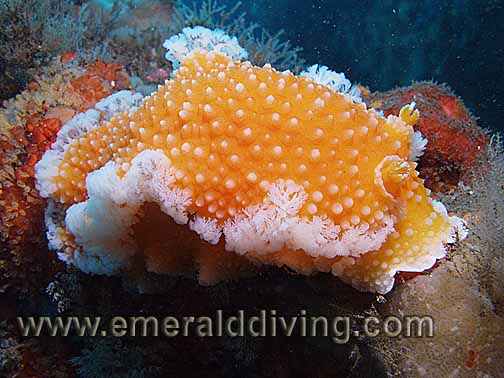
On land it's hard to get excited about slugs and, whenever we encounter one, we usually do our best to avoid touching them.  Under water it's a completely different story with what are known as sea slugs or nudibranchs.  "Nudis," as they are affectionately called by divers, are spectacular in their colours, shapes and markings.  Looking like slugs or hedgehogs or a combination of anything in between, these frilly orange, yellow, white, purple, and translucent animals have names like sea lemon, orange peel, shaggy mouse, and Spanish dancer, and are a particular delight to catalogue and photograph.

Alabaster nudibranch
Orange peel nudibranch

Giant dentronotid

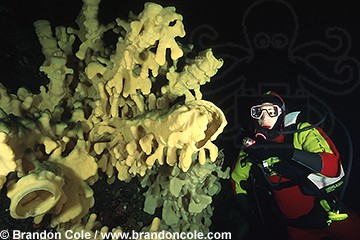
Another interesting group are the sponges which come in all sorts of shapes and sizes.  From orange tennis ball types, and yellow and purple patches forming crusts on the rocks, to massive and intricate cloud and chimney sponges that often have small fish and other creatures living inside them.  Chimney and cloud sponges can be found at depths of up to a few thousand feet but generally they are in the 80 - 100 foot range which is near the maximum depth a recreational diver is permitted to descend.

Cloud sponge
 
Chimney sponge

One of the principal pleasures of diving is discovering new sites and cataloging the creatures living there.  All it takes is the right combination of nutrient carrying currents and a strategically placed reef, wall, or shipwreck, to make it all come magically alive.  However, like any woman who wants to maintain her allure, there always has to be a little mystery, and so it is with the green eyed lady who keeps it all underneath waiting for an intrepid diver to discover.  More to follow.

Nelson & chimney sponge photo by Joseph Blackburn

Muddy Waters

Throughout the fall and winter months I get to enjoy the clear waters of English Bay for my daily swim but, as things start to warm up, this soon changes and, by late spring, the ocean is cloudy and filled with sediment from the annual spring snowmelt runoff of the nearby Fraser River.  Flowing for more than 1,375 kilometres from Fraser Pass near Mount Robson in the Rockies to the Strait of Georgia, the actual amount of water the river carries is dependent on the melting snow but, by the time it reaches Georgia Strait, it's discharging an average of 8,000-10,000 cubic metres per second into the ocean.  (In the winter this goes down to around 1,000 cubic metres per second)  In June 1894 the record was set at 17,000 cubic meters per second.  Along with all this fresh water is an estimated 20 million tons of sediment that gets dumped into the ocean.

Satellite view of sediment plumes from the Fraser River meeting Georgia Strait
There is so much sediment being carried by the Fraser River, it can easily been seen from outer space and, over the last 10,000 years, this great pile of sediment has accumulated as a delta where the Fraser River flows into the Strait of Georgia.  The tidal flats and marshes of this delta are vital habitats for salmon fry and migratory waterfowl and, as the river mixes in with the salt water of the ocean, an important exchange of nutrients and natural flushing takes place that has a profound impact on the surrounding ecosystem.  Countless scientific studies have been done to try and measure the impact on salinity, water temperature, plankton growth etc. but the most obvious effect of all this sediment is that the delta formed at the mouth of the Fraser just keeps expanding.  In the charts prepared by Natural Resources Canada, you can compare the changes that have evolved over the past 10,000 years, with this annual outflow of sediment.

Fraser River delta and floodplain 10,000 years ago

Fraser River delta and floodplain 5,000 years ago

Fraser River delta and floodplain today
In the past this annual spring runoff would produce widespread flooding in the Fraser Valley with the Fraser River depositing silt and clay over the floodplain to build up an incredibly fertile farmland, much like the annual flooding of the Nile.  In the 1900's however, construction of dykes was started from Agassiz to Georgia Strait, protecting 65,000 of the 75,000 hectares of floodplain from Hope to the mouth of the Fraser which is mostly farmland but also includes the cities of Chilliwack, Mission, Abbotsford, New Westminster, and Richmond. Other than some minor flooding in 1972 there hasn't been a major flood since 1948 when the dykes were breached and 1/3 of the Fraser Valley was again flooded.

Aerial view of 1948 flood
While dykes have contained the flooding, it has also meant there is no more fresh silt and nutrients being deposited on the land as a natural fertilizer.  Fertilizer now has to be added to farmland, along with pesticides and other chemicals, all of which eventually leach out through the ground water table and back into the river. But not all of the silt is carried to the ocean or settles in the expanding Fraser delta, a large portion simply settles in the river bottom and clogs up the shipping channels.

River dredge
In order to keep these shipping channels open the Port Authority has to maintain an active dredging program.  In fact the Port Authority estimates that it it dredges out 3.5 million cubic metres of silt and sand annually just to keep up, which in itself is enough to fill Rogers arena.  Dredging, however, is only carried out on the primary channels as there is no budget for dredging secondary channels and, as they fill up, this is causing all sorts of other issues for the affected municipalities.


While much of the dredged sand & silt is in turn used in land reclamation projects, and sorted for various uses by sand & gravel companies, a good portion is added to the edge of the river delta itself.  However, as less and less of the delta is being maintained for farm use, and more of it is being used for housing needs and expanded port infrastructure, the risk has now shifted from one of flood to one of slope failure on the outer edge; an underwater landslide as it were.  It has happened before and it could happen again, and the forces that could cause this range from ocean wave activity to an earthquake.


Earthquakes pose special problems for the Fraser delta because conditions are perfect for liquefaction to occur.  Liquefaction is a phenomenon caused by earthquake shaking which turns loose, water-saturated sediment into a fluid (liquefaction). When sediments liquefy, the ground may subside irregularly, causing buildings that are not properly anchored to tilt or collapse. So, try as we may to control the Fraser River with dykes and dredging there are still many unintended consequences to factor in our plans.  In the meantime I'll just wait for the muddy waters to settle like they always do and then things will be clear again.

Tuesday, May 1, 2012

Bye Bye Love

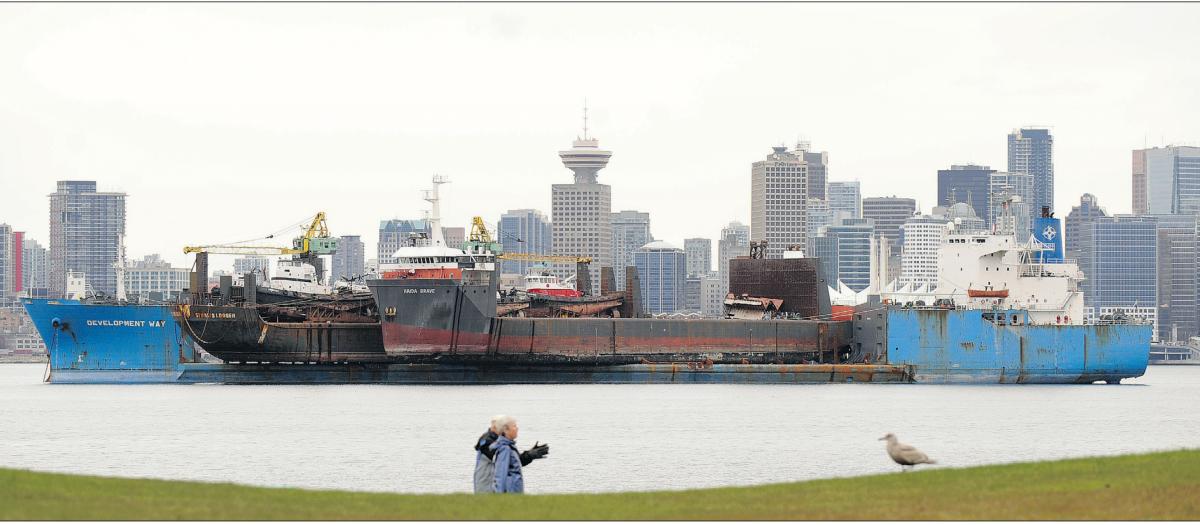
Development Way

Vancouver residents with a view of the harbour were treated to a strange sight this April when the heavy lift vessel  "Development Way" headed out with a load of scrap vessels strapped across its deck.  The cargo included two self-loading/unloading log barges the "Straits Logger" and the "Haida Brave" and 8 tug boats.   All part of a spring cleaning project for Seaspan as it gets its dockyards in shape to make room for the big shipbuilding work set to begin for the federal government.


What it really signifies is the end of an era and, one that few of Vancouver's citizens give much thought to these days.   These massive barges, built in the 1960's & 70's, were used to transport millions of logs, harvested by various logging camps up and down the coast, and to deposit them outside the sawmills and pulp mills where they were then processed.  Thousands of people were employed in a multitude of direct and indirect jobs related to the forest industry, and it formed the backbone of the British Columbia economy.

Straits Logger

Now of course the forests are almost all gone, as are the logging camps, sawmills, and everything that goes with it, and the workhorse boats of the west coast are heading for China to be put to other uses, or dumped into an industrial version of the glue factory. Such is the nature of change.  Still it's hard to believe that such a dominant industry of the Province has practically disappeared in such a short time.

Haida Brave
Another group of ships that followed the same route to China, after Seaspan picked them up for their scrap value, were of course the infamous fleet of fast cat ferries.  Built at great expense, without thinking things through, they had an even shorter life span than the forestry vessels, and the fallout set our local shipbuilding industry back quite a few years.  More than a few hearts were broken when these boats were loaded up on another heavy lift ship "Dockwise" and sent to the glue factory. 

Dockwise

But it hasn't only been one way traffic for these heavy lift ships.  In return for all the scrap going to China, other heavy lift vessels like the Zhen Hua have been steadily delivering Chinese built gantry cranes to handle the ever increasing business of loading and unloading container ships.  Container ships that are carrying predominantly Chinese made goods.  This is the new economy for Vancouver, a transshipment port where containers to and from Asia get off-loaded to and from railways and trucks that transport them throughout North America. 

Zhen Hua
It's a business that serves some cities very well, most notably Singapore, the busiest transshipment port in the world.  Of course we have a long way to go when you compare the 400,000 annual transshipping TEU's going in and out of Vancouver with the 17.5 million going in and out of Singapore.  Vancouver's total container movement is only 2.5 million TEU's annually so we have lots of room to grow if we ever want to become a true world class shipping port and quit kidding ourselves about where we stand in comparison to everyone else.

Exxon Mobil refinery in Singapore
In fact we could learn a lot from Singapore with its population of only 5 million people living on less than 300 square miles of land, but still manages to be the; 5th largest financial centre in the world, 5th busiest port in the world, 2nd biggest gambling casino market, 3rd largest oil refining centre in the world, and boasts the world's 3rd highest GDP (PPP) per capita.  In terms of oil refining alone, compare just one of Singapore's refineries with a daily capacity of 605,000 barrels with the refinery in Burnaby which has a capacity of only 52,000 barrels per day.

Burnaby Chevron refinery
Lately there's been a lot of talk about the expansion of the Kinder Morgan pipeline into Vancouver to move more Alberta oil to the Far East.  It's just the latest example of Canada being nothing more than a "hewer of wood and drawer of water" without any regard for the environment.  Worse, without any refinery process along the way, there is no long term benefit to B.C. because there is no metering charge we can levy on the oil itself.  All we get is the one time construction jobs to build the pipeline.

Kinder Morgan pipeline
It's so typical of our approach to resource management in this country; mine it, log it, fish it, pump it, whatever it, until "it" all runs out.  If we thought like Singapore we might at least get some jobs out of the deal. Perhaps oil transport will be the new indirect industry of this province and, instead of log barges, we will be looking at oil tankers going through our harbour.  If this is the case, then we should at least build a massive refinery complex and process the oil before shipping it out. Singapore has found a clean and profitable way to make this work so what's wrong with us?

Oil Tanker
Regardless of whether it's raw tar sands oil, or refined petroleum products, being loaded onto oil tanker ships, or an endless parade of container ships, we aren't talking about logs anymore.  Those days are over. As the ships try their best to navigate our treacherous coastline it's, bye bye love to the old forestry gals and hello loneliness, I think I'm going to cry.

photo by Arlen Redekop

Sunday, April 22, 2012

Like A Rolling Stone


English Bay beach low tide photo by Junie Quiroga
In Vancouver the only time anyone gives any thought to the tides is usually when they are either playing on the beach or going for a walk along the seawall.  When the tide is in (high tide) there's only a narrow strip of exposed sand at each of the beaches with everything otherwise covered by the ocean.  But when the tide is out (low tide) the muddy bottom and all of the ocean's dirty laundry is left exposed, with a jumble of rocks and boulders dominating most of the shoreline.

Low tide rocks west of 2nd Beach photo by Junie Quiroga
Where all the rocks came from in the first place is a geological mystery of its own, though some have obviously been put there by engineering crews to create mini breakwaters and stave off the erosive effect of the ocean.   It's so rocky that, as you walk along the seawall, you quickly realize how fortunate it was that a beach like English Bay even came into existence.  Though in actual fact that beach needed a little help from city hall to get enough sand to make it what it is today.

More rocks and boulders along the seawall
Added to the mystery of these rocks and their random placement is a certain beauty that goes with their wildness. However, what's fascinating about all these rocks isn't so much how they got here but what the locals have done with them.  One example being a painstakingly cleared path someone made just so they could get to the water.

Pathway to the ocean photo by Junie Quiroga


Steps Beach photo by Junie Quiroga
Another is the alcove that has been created by using the stones and a little mortar to reinforce the hill, install some steps to access the beach, and put in some seating.  Obviously quite a collective effort has gone into this project, because the group also cleared an area of the waterfront and used the rocks to build a breakwater. It has become quite a popular spot for folks to gather and socialize and, in the process, they have created a new beach.

Steps Beach photo by Junie Quiroga
Balancing Sculptures photo by Junie Quiroga

But my favourite use of the stones and imagination is the little balancing sculptures that folks are always putting together.  Whether it's making little Inukshuks or creating whimsical creatures, it seems to breathe life into the stones themselves, and builds a unique existence for them out of the randomness of their particular surroundings.  Life is what you make it, even for a rolling stone.

Balancing stone sculptures

Monday, April 2, 2012

We Are Family

Great Blue Heron photo by Junie Quiroga

Often on mornings when the tide is going out there's another group of early risers waiting for me to go for my swim, and that's the local great blue herons.  Without any benefit of tide tables or alarm clocks they seem to know the days and times of low tide and when to get out there and go fishing.  Patient and quiet, unless you happen to get too close which may result in a squawk at you to mind your distance, they stand knee deep in the water taking full advantage of their long legs to wade around and wait.

Great Blue Heron beach photo by Junie Quiroga

Whether they are a little self conscious of their height (standing up to 5 feet with a wingspan of 6 feet) or it's part of their hunting strategy, they are usually standing with their long neck curled up but poised to spring as soon as something edible happens by.  Their long, sharp, bill makes for an excellent spear and, while fish are their preferred meal, they aren't averse to snagging crabs, frogs, or even mice for that matter.  It's a good diet too because on average these birds live for 17 years.

Great Blue Heron in Lost Lagoon photo by Junie Quiroga

Heron nests in Stanley Park photo by Junie Quiroga
What's really intriguing about the Great Blue Heron is their incredible sociability, with groups of them nesting together in a "heronry" that can get up to 500 nests.  For some reason in the year 2000 a group of them got the idea for a millenium project and started nesting in the trees above the Parks Board office in Stanley Park.  Good recyclers, they use the same nests every year once they've done a little spring cleaning, and the heronry has now grown to over 100 nests, though 2010 was the peak year with 145 nests and 175 fledglings being produced.

Heron's tending their nests photo by Junie Quiroga
There are 5 distinct sub-species of Great Blue Herons throughout North America, with most of them migrating south in winter.  But the ones in the Pacific Northwest stay here year round, realizing that just because it rains a lot it doesn't mean you have to spend all that time and energy, not to mention money, heading to South America with everyone else.  Other than the nasty raccoons who are always trying to get at their eggs, living in Stanley Park seems to suit these birds rather well, and they don't seem to mind all the people either. 
  
Great Blue Herons living the beach life photo by Junie Quiroga
Having English Bay close by with all the amenities also adds to the pleasure of living here.  Where else can you get a water slide, hot dogs and a cold beer right on your doorstep?  For the Great Blue Herons in Vancouver, life is a beach and, with over 100 nests and at least 2 adults and one fledgling per nest, that adds up to over 300 herons calling this place home.  Quite a family indeed.